Every pedal set measures your input a different way, and the brake pedal is where that difference actually shows up on track. Throttle and clutch inputs are simple on-off-ish motions, but braking is where consistency separates fast laps from inconsistent ones — and that consistency comes almost entirely from the sensor under your foot.
Potentiometer: travel, not force
A potentiometer measures how far the pedal has moved, the same way a volume knob measures rotation. It's cheap, reliable and perfectly fine for throttle and clutch, but on a brake it means you're braking by distance rather than by pressure — press the same amount every time and you get the same braking force, but your foot has to learn a travel distance rather than a feel, which is harder to repeat precisely under race pressure.
Load cell: force, not travel
A load cell is a small strain-gauge sensor, the same technology used in a kitchen scale, mounted so the pedal barely moves and instead measures how hard you push. This matches how a real car's brake works — pressure, not distance — and it's the reason load cell brakes feel more natural and more repeatable almost immediately. Most drivers find their braking consistency improves within a single session of switching from potentiometer to load cell.
Hydraulic: the closest thing to a real brake
Hydraulic pedal sets replace the spring or elastomer behind the brake with an actual brake cylinder and fluid or air line, giving genuinely progressive resistance that firms up the harder you press, just like a road car. They usually still read force through a load cell or pressure sensor, so the sensor technology is similar to a load cell set — the upgrade is the pedal feel itself, not a new way of measuring your input. It's a smaller jump in realism than potentiometer-to-load-cell, at a noticeably higher price.
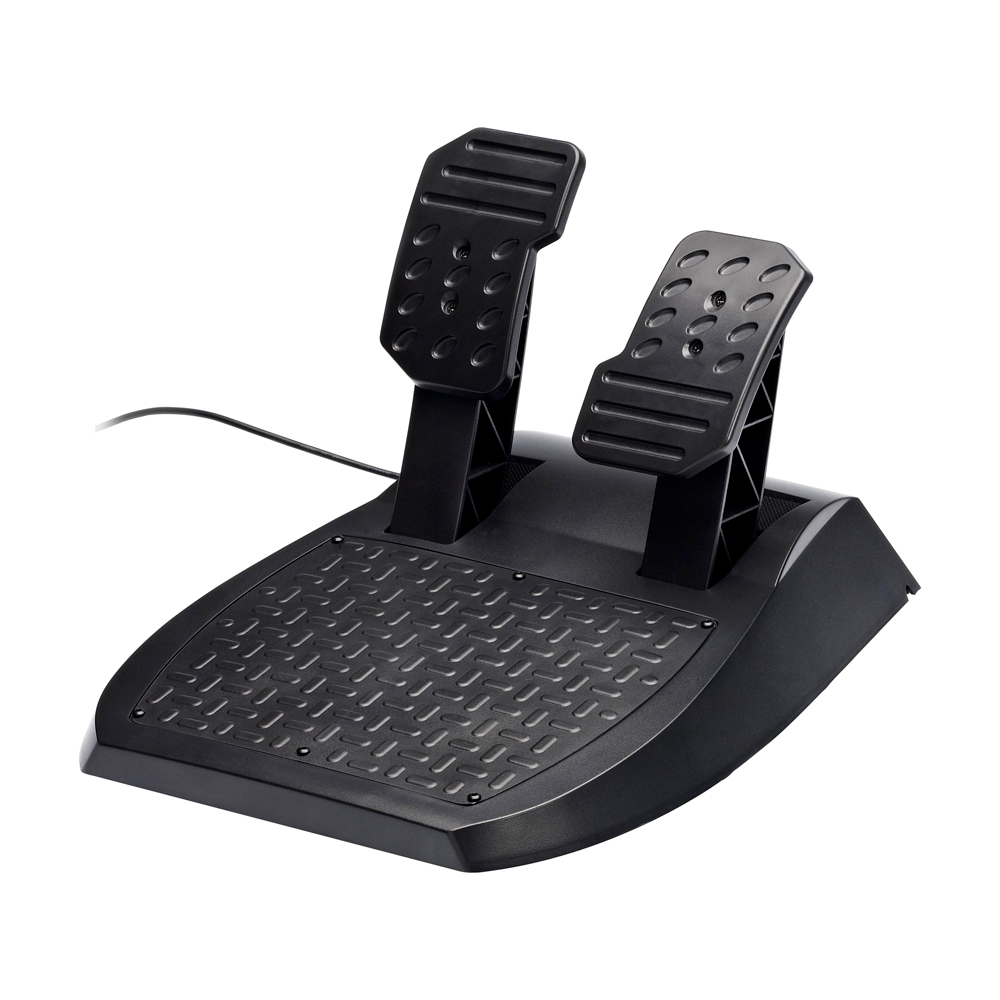


| Sensor type | Measures | Typical price (set) | Best for |
|---|---|---|---|
| Potentiometer | Pedal travel | Under €100–150 | First pedal set, throttle/clutch, tight budgets |
| Load cell | Force applied | €200–500 | Most drivers who want consistent, repeatable braking |
| Hydraulic | Force, via a real brake cylinder | €500–1,200+ | Drivers already consistent on a load cell who want road-car feel |
Console vs PC compatibility
On PC, almost any USB pedal set works with any wheel base, since the pedals and base are separate USB devices as far as your sim is concerned. On PlayStation and Xbox, pedals typically plug into the wheel base rather than the console itself, so they generally need to be from the same brand as your base, or use a specifically supported adapter. Check the compatibility filter on the pedals page against the wheel base already in your build before buying.
2-pedal vs 3-pedal sets
A 2-pedal set (throttle and brake) is all you need for paddle-shift or automatic driving, which covers most modern GT and open-wheel cars in the popular sims. A 3-pedal set adds a clutch, which only matters if you regularly drive manual-shift content or want the extra immersion — it's an easy thing to skip on a first set and add later, since clutch pedals are commonly sold separately as a pedal accessory.
Once you know which sensor type fits your budget, compare real pedal sets with live prices and platform compatibility on the Pedals page, or start a full build from scratch on the SimRigPicker home page.
FAQ
Is a load cell brake worth the upgrade?
Yes, for most drivers it's the single biggest consistency upgrade after a wheel base. Load cells measure the force you apply rather than how far the pedal moves, which matches how a real brake behaves and makes your braking point repeatable lap after lap.
Do I need a hydraulic pedal set?
Only if you already brake consistently on a load cell and want the last bit of realism and adjustability a real brake cylinder provides. Hydraulic sets cost noticeably more for a smaller feel upgrade than going from potentiometer to load cell in the first place.
Do pedals work with any wheel base?
On PC, most USB pedal sets work with any wheel base. On PlayStation and Xbox, pedals usually connect through the wheel base rather than the console directly, so they generally need to be from the same brand as your base or use an officially supported adapter.